
Combat and Input Randomness in Skyrealms of Jorune
How initiative works in this notoriously obtuse ttrpg from the 80s, why it's actually brilliant, and how I'd steal it for a pulp sword-and-sorcery game

I’ve been listening the actual play podcast Play To Find Out by Quinns Quest, where they play notorious old ttrpgs from history. For Season 1, they played Skyrealms of Jorune, a science-fantasy game from 1984. It’s insane, hilarious, and over-complicated in a very 80s way. But there’s a nugget of gold under this mountain of rules…
I’m Colin, and I’m a professional video game designer. This is Drolleries, where I write about d&d, ttrpgs, and game design.
The Combat System
Like many rpgs from the 80s, combat in Skyrealms of Jorune is needlessly complicated. Every factor is simulated, and there’s enough charts to scare off your players (and friends). Here’s how it works.
First, you roll for advantage: d20 plus your skill with the weapon you’re wielding, as well as penalties for injuries you’ve taken (more on that later). Your result for advantage determines your order in combat, as well as the types of actions you can take. Here’s the chart of possible results:
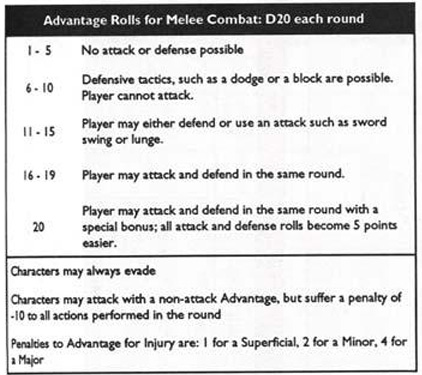
Interestingly, this means you can only attack in combat if you roll an 11+ on a d20. The rules point this out, saying:
Depending on the advantage rolls, several situations are possible. If both players roll 10 or less, then neither one may attack. The round counts as rest for both combatants, and both players immediately re-roll their advantage. This happens a quarter of the time. The typical situation is that at least one player is able to attack.
You might think this means that your advantage roll is really important, seeing as you can’t even defend yourself if you roll low enough. Well, kind of.
How do I attack?
Roll to hit with your weapon. That’s a d20 under your weapon’s rank. If you’re “familiar” with your sword at Rank 10, then that’s about a 50% chance to hit.
Then, if your target can defend, they roll to defend. That’s also d20 under their weapon’s rank, also about a 50% chance to defend. Even if your target can’t defend, they can still choose to “evade,” which is an agility check, so the odds vary based on their character’s stats.
So overall, that’s about a 20-30% chance you made it this far.
Okay, I do damage then, right? Not too fast. We gotta consult the charts.
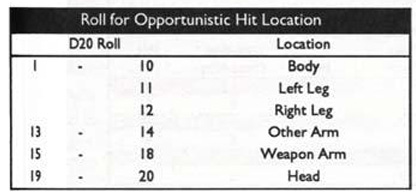
First, roll d20 to determine where exactly you hit your target. Obviously.
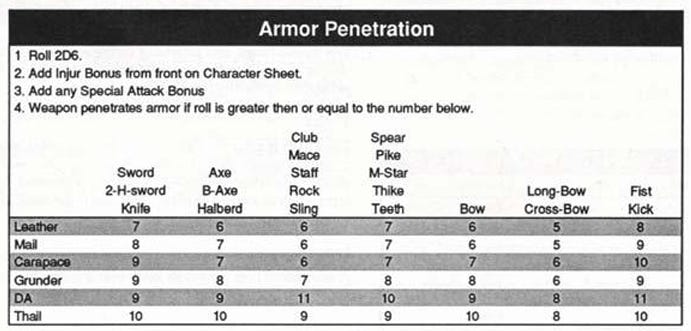
Then, if your opponent is wearing armor on the specific body part you hit, you roll 2d6 to see if your weapon penetrates their armor, then look up your result on the following chart based on their armor type and your weapon type. If you beat the number, that means the weapon penetrated their armor, and you can move on.
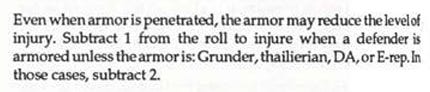
Now we can determine the severity of the injury. Roll 2d6, but subtract either 1 or 2 depending on the type of armor. Wait, but didn’t we say we penetrated the armor?
Then, you look up your result on this monster chart.
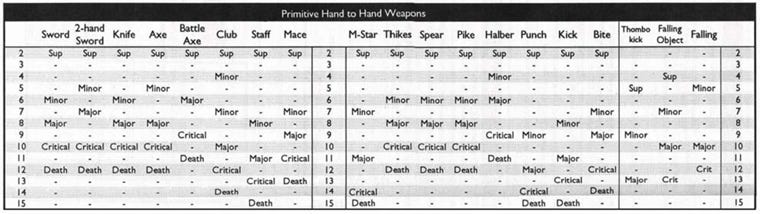
And that’s the type of injury you deal. Simple and easy, right?
Also, if you’re using a ranged weapon, there’s a whole other set of modifiers based on if your target is stationary, walking, or running that affect your odds to hit, as well as a different injury chart. Not to mention if you try to cast a dysha, you have to first roll to manifest the dysha, as well as spend the required isho points.1
All these rules bog down play and increase the chance of nothing happening. What should be a fast and deadly combat turns into a minutes-long math exercise that just delays the inevitable. And the sheer number of steps (rolling for advantage, rolling to hit, rolling to defend, rolling for hit location, rolling for armor penetration, then rolling for injury) maximizes the chances of a miss. So even if you succeed on advantage and succeed on your to-hit roll, there’s still a good chance nothing happens. Nothing happening is the most common result, which brings the pace of the battle to a grinding halt.
In practice, these rules actually diminish the importance of the advantage roll. If the outcome of an attack depends on so many random rolls, it puts less importance on any one of those rolls. Even if you succeed on your advantage roll, it doesn’t mean much, because you still have to pass a gauntlet of 5 more rolls in order to have an impact.
Benefits of the Advantage Roll
However, in theory, the advantage roll does have some interesting benefits that inspired me.
First, and perhaps most importantly, you accumulate penalties to your advantage roll every time you take an injury. This means that it’s possible to get to a point where with two minor wounds (two -2s, total of -4), the chance of you being able to attack goes down from about 50% to about 30%. Especially when players are rolling with a large penalty, it becomes clear quite quickly that a fight can become basically unwinnable after you’ve sustained enough injuries. It’s a massive death spiral staring the player in the face, and it’s even more obvious than in other systems, because it affects the possible actions you can take and it’s the first thing you do each round.
This lays bare in front of the players the deadly nature of the system and encourages them to try other approaches. Once a fight is clearly unwinnable, players can try other noncombat solutions, like bargaining, surrendering, or otherwise negotiating for their life.
The same is true for the GM. Once the players inflict heavy injuries on their enemies, the GM is encouraged to have enemies surrender and negotiate with the players. This naturally creates the kind of behavior encouraged by old-school systems using morale rolls. But in this case, it’s not up to GM fiat, it’s an inevitable consequence of the combat.
All this means that fights don’t always end in death, as they do in 5e and even many OSR systems. In my opinion, this is a more interesting narrative space, especially for sword and sorcery adventure stories that feature mostly human villains and grey morality.
Input Randomness
The advantage roll is an example of what’s called input randomness, where the random outcome happens before the player makes a choice. This is contrasted with output randomness, where randomness determines the consequences of the player’s choice. Output randomness can sometimes feel frustrating and arbitrary, and input randomness can sometimes give players more agency. Mark Brown from Game Maker’s Toolkit on YouTube has a great video on this topic:
Many video games that encourage tactical decision-making prioritize input randomness, such as Slay the Spire and Into the Breach. This is because output randomness can feel frustrating when the player’s strategy is foiled by random chance. Input randomness instead feels like the player is making decisions with the cards they were dealt (quite literally in the case of Slay the Spire), which can feel less random to players.
But for ttrpgs, output randomness is the tradition, almost the law. The player states their intention, then we roll dice to see what happens. Depending on the system, the randomness might tell us the odds of success or the level/quality of success, or maybe the consequences incurred even if you’re assumed to succeed. Still, most systems use output randomness to resolve player actions. And many good-natured players don’t mind if their attempted action fails due to output randomness, as long as the outcome is interesting and dramatic and the odds were known.
But would a ttrpg system look like if it leaned more heavily on input randomness? I think the advantage roll is a great mechanic to explore this.
Redesigning the Advantage Roll
My goals for this redesign is to emphasize the importance of the advantage roll by drastically increasing the odds of an attack’s success. With no roll to hit, no roll to defend, and no roll for armor penetration, there’s less chance for a null result.
However, if the target makes the choice to defend (and has the option to), then I’m okay with a nearly 50% chance of a miss, because it justifies the defender’s choice to use their action defending, further emphasizing the advantage roll.
Also, missing is an important part of the fantasy of ranged attacks (especially guns in the science-fantasy setting of Jorune). The dramatic question for melee attacks is “how bad will I injure this guy?” but the question for ranged attacks is “will my shot hit this guy?” So ranged weapons are faster and safer because of their range advantage, but they don’t have defense and they can miss.
Another key issue with the advantage roll in the original rules is that it’s incredibly swingy as a d20. If I’m going to vastly increase its impact, it’s important that players don’t feel like it’s arbitrary. Because any roll could mean death, modifiers need to feel significant and there should be a “most common” result that players can expect. I’ll use 2d8 to generate a bell curve of more predictable results.
And it should go without saying that I’m doing away with most of these huge multi-column tables in the pursuit of speed. Two small charts is enough.
My System
Each round of combat, everyone rolls for advantage. Roll 2d8, adding the speed of the weapon you’re wielding. The result determines the actions you can take this round, as well as your bonus to your injury roll.
5 or below: only movement
6-8: only defend
9-13: choose either attack or defend
9: no bonus to injury roll
10-11: +1 to injury roll
12-13: +2 to injury roll
14 or above: both attack and defend, +3 to injury roll
In ascending order of advantage (from lowest to highest), anyone who rolled between a 9-13 must declare whether they’re attacking or defending this round. Then the GM resolves everyone’s actions in descending order (from highest to lowest).
Attacking
When you attack, roll the injury die of your weapon (d4, d6, or d8) and add a bonus based on the result of your advantage roll, if applicable.
1 or below: miss
2-4: if melee, scratch (-1 to advantage); if ranged, miss
5-6: minor wound (-2 to advantage)
7-8: major wound (-3 to advantage)
9 or above: critical wound (KO’ed and dead in minutes unless treated)
Wounds & Armor
Scratches, minor wounds, and major wounds give you a penalty to advantage rolls until treated. A critical wound takes you out of the fight, and you’ll be dead in minutes unless treated.
You can take maximum 3 scratches, 2 minor wounds, and 1 major wound. If you take an additional wound over your maximum of that type, it becomes the next-highest type of wound.
Armor negates a certain number of wounds per combat equal to its protection.
Defending
When you’re attacked, if you have the option to defend, choose one of the following options. You can only block or parry if you’re wielding a melee weapon.
Evade. The injury total is reduced by 1d10, but you have -1 to advantage next round.
Block (vs melee only). The injury total is reduced by your weapon’s defense. You have +1 to advantage next round.
Parry (vs melee only). Roll 1d6. If the result would reduce the injury total to 1 or below, the attack misses and you have +2 to advantage next round. If not, the injury total is not reduced.
Weapons & Armor
Using the weapons from Skyrealms of Jorune, I took their original stats into account when coming up with my statistics. Then I sorted them into rough rarity categories based on their actual prices in the 3e rulebook, and balanced their stats accordingly.
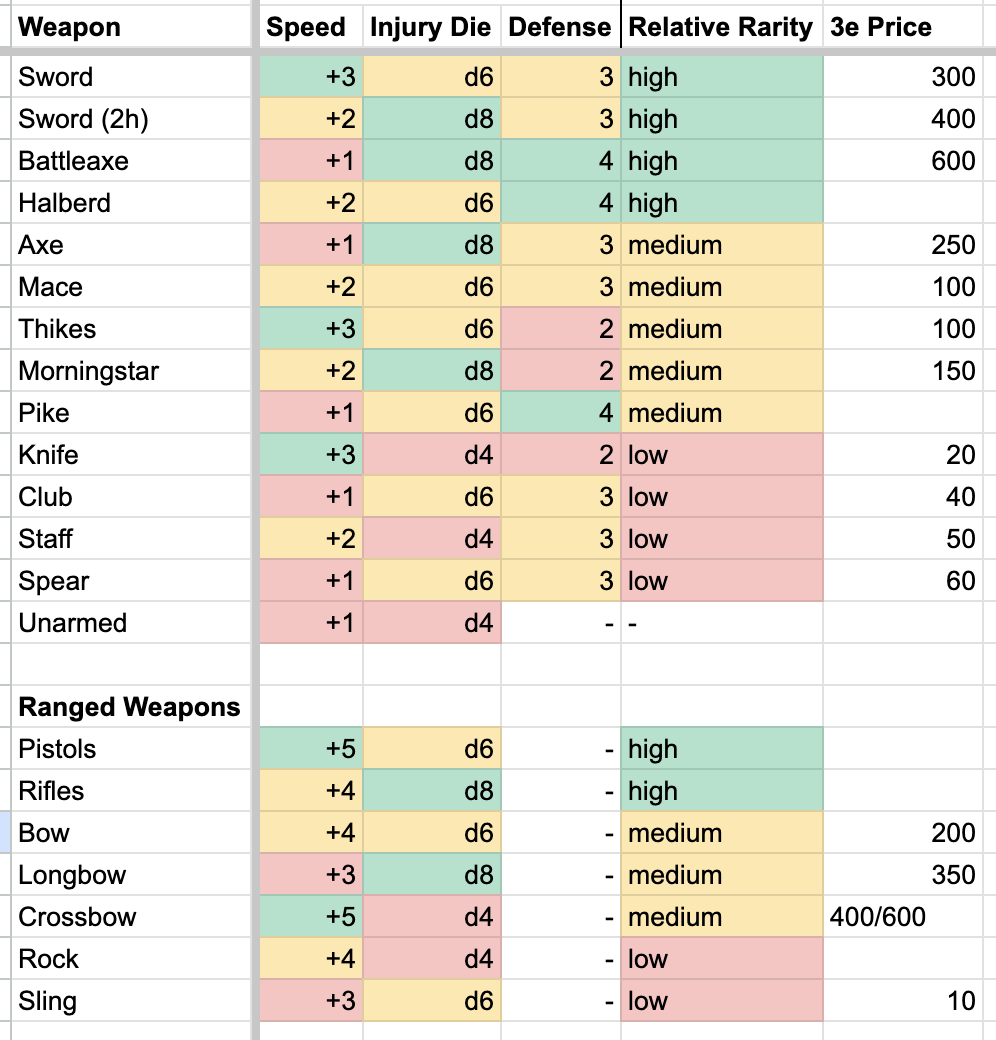
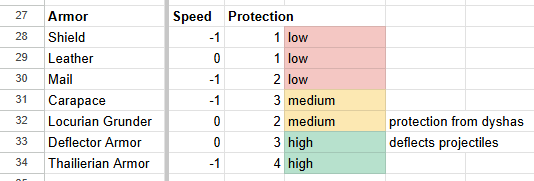
See the full spreadsheet here: https://docs.google.com/spreadsheets/d/14yGtcT82lBr7QTiC6h67yRX6BWu3pTMcLUAAso8FUmU/edit?usp=sharing
What’s Missing
Skyrealms of Jorune’s original rules are bursting at the seams from too many mechanics and systems, so inevitably I’ve left some out of this prototype. There’s no penalties for shooting ranged weapons at moving targets. There’s no 3-range melee combat system with advance and withdraw maneuvers to get past the range of a polearm. There’s no attack maneuvers like lunge, overhead swing, and feints.
But one system that I do think would work well in a gritty & deadly combat system like this is called shots. The original game had rules for targeting the head, arms, legs, and torso to ignore certain armor and impose different effects, which I think could work well with the wound system and create more interesting seeds for storytelling rather than just “major wound” or “minor wound.”
Takeaways
This exercise was a lot of fun! It was interesting taking a look at a combat system that emphasized input randomness, and especially one that’s very gritty, very deadly, and features a pretty harsh death spiral on purpose.
This makes me want to actually run a game of Skyrealms of Jorune! If I do, I’ll definitely write about it.
Also, go watch Episode 1 of Play to Find Out to hear Quinns and his friends play Skyrealms of Jorune!
isho = magic, dysha = spell
My friends and I played Jorune when I was a kid. This is a blast from the past :)
Quivering Trid-nodes! Great article and also a massive nostalgia hit in one.